
The Relationship Advantage Service Providers Are Missing
What relationship advantage are service providers missing?
The conversation with Michael Hopkin, a business coach and growth strategist, delves into the essential aspects of building and growing a business.
Be prepared to Be-Picked.

Learn more about the host
Episode 18 · Listen now
Watch the episode
Brief summary of the show
The conversation with Michael Hopkin, a business coach and growth strategist, delves into the essential aspects of building and growing a business. From defining the role of a business coach to identifying the ideal client, attracting the right clients, and creating value, the discussion emphasizes the importance of trust and effective marketing strategies. The conversation concludes with a plug for Andrew Colsky's upcoming book and a final word from Michael Hopkin.
See where your credibility stands
Take the free AQ Assessment. Twenty questions show how AI search sees you and what to fix first.
Take the free AQ AssessmentKey takeaways
What you'll learn
- Building trust is essential
- Identifying the ideal client is crucial
Chapters
- 00:00Introduction and Definition of Business Coach
- 05:38Attracting the Right Clients
- 24:50Mistakes in Marketing and Building Trust
- 30:26Book Plug and Final Words
Full transcript
Read the full transcript
Andrew Colsky: Welcome to Be Picked, the podcast where we talk about how professional service providers can build and grow their businesses. got all sorts of tips, tricks, and traps to avoid. How about that? Today, we are meeting with Michael Hopkin. He is a business coach and growth strategist, ⁓ I should introduce myself. I'm Andrew Colsky, the host of Be Picked. So, ⁓ welcome to the show.
Mike Hopkin: Thank you, Andres. Great to be with you today. How are you?
Andrew Colsky: I am doing great and we get another half hour here where we can talk about building businesses and that's something I love to talk about. So time is gonna fly by. ⁓ So in your title, it says business coach. So why don't we start off with a definition? What exactly is a business coach? What do you do and what type of people do you work with?
Mike Hopkin: Yeah. Well, that's a great question or set of questions. am, so the business, there's different types of business coaches, but where my focus is, is on working with businesses to grow their revenue and to just make their, know, do things that will help their business be more successful. ⁓ And the type, you know, I've worked with customers in a lot of different industries. You know, I've had customers in the trades like HVAC customers, plumbing customers, people that have those kinds of businesses. A lot of my background, my personal background has been in technology. So software, particularly software product development. And so a lot of my customers have been technology based customers. So customer, ⁓ clients that maybe have a business where they're doing AI products, or they're doing, ⁓ one of my clients has a product, a great product where he, it's an app that helps you be more healthy and different things like that. and then I've had some ⁓ various clients and other, one of them like, helped people get their houses ready to become Airbnbs, different things like that. So I've worked with a lot of different businesses and what I found is that the principles that I work on will work in just about any industry or any type of business. So, well that's been good.
Andrew Colsky: Mm-hmm. Well, it's, you know, you're in the right place ⁓ because ⁓ for the listeners who may not know, ⁓ we're also, BePicked is also a software company, meaning we have something called the Credibility Generator. And the Credibility Generator is a piece of software that we've developed that helps you take all the lessons learned through all the work that we do here and all the lessons we share here. and it automates it for you. So all the things you're thinking about in terms of, wow, that sounds great, but where am I going to find the time? We just gave you all your time back. So you can visit us at vpick.com and take a look at that. But this is not a show about that. This is a show where we're talking with Michael Hopkins. So tell us sort of from the beginning when people think of building their business, they've got things like they can
Mike Hopkin: That's cool. ⁓
Andrew Colsky: take out ads, they can hopefully get referrals from people, they can do a social media campaign. There's a lot of different options available today. So when you're working with someone, where do you start?
Mike Hopkin: Yeah. You know, so let me just, let me back up one step. Because what I've found, when a lot of people build their business, before they even think about taking out that ad or doing something on social media or something like that, before they ever think about how are they going to get their customers, they have been doing something prior. Maybe they were at a corporation and they had a corporate job and they got really good at marketing or they got really good at something, you know. And they decided they wanted to build their own business. And so what I found in working with a lot of small business owners is that they're really good at the core service or product that they provide. If it's a product, they really know that product. They built it. They know how it works and they know how people can use it and be effective and get a lot of value out. But what they don't really think so much about is, how do I build a business around that? And so that's what I've really found, that's the place I've really found I could help people is, how do you build a business around, you you were the best plumber and everybody loved you, and when you started your business, you already had 15 customers, because they just, when they heard you were going on your own, they were like, I'm in, you know. but then they start and they wanna build their business and grow it and that's where I help them. so now that I've said that and I backed way up, I forgot what your question was. ⁓
Andrew Colsky: Well, the question was following from that sort of, they've now started, they have their own shingle out there, right? Where do they go from there? So for example, you know, because I'm one of these people, I've had my own and still have my own professional services business, small intentionally, ⁓ and I have to get clients.
Mike Hopkin: Yeah.
Andrew Colsky: And the same thing that I hear from a lot of my colleagues is, well, I get a lot of calls from people, but they're not the right clients. And so they end up taking a lot of time on the call, but they don't actually become a client. And now I've just lost all that time where I couldn't get actual work done. So why don't we start with that question? How do you go about making sure that you're attracting the right clients and what do you do to attract them?
Mike Hopkin: you That's a great question and that is one that I have dealt with all my clients with. And where I start is I start and I just ask them this question, what is your position of market dominance? And a lot of times that kind of takes them off guard. They're like, what do you mean? I am a small business. How can I have a position of market dominance? I'm just a plumber. I have an HVAC business. How do I? And I'm like, okay, well tell me a little bit about who do you serve? And I work up to talking about the market that they're in, know, because all businesses are in a market. And the idea of having a position of market dominance is that in the market where your business operates, you are the very best at that. And so I help them kind of just dig through everything, you know, and figure out what are they the very best at. And that is where we start to build out their messaging. Because once you have that part nailed down, and then, well, so part of getting your position of market dominance is not only what are you the best at, but who are the clients that most need it? Who are your ideal clients, your ICPs? Who are the ones that really need what you, either the service you provide or the products that you sell? Who are those people? And then we start, we build out the plan of how do you go about connecting with them, speaking about what you do, and by speaking it could be on social media, it could be, you know, there's a lot of different ways to quote, speak, could be actually speaking at conferences. There's a lot of different ways to get them, it's just about getting that message out. How do you do that effectively? And so that's where, you know, that's. And that's a big part, know, if I work for a client for a year, that might be three or four months worth of work that we're doing to get that going and get it to where it's really starting to bring leads and people in. the idea, you know, what I ultimately want to help my clients do is get to the point where they just have people finding them because they're in the right places. They have the right message. They're doing things that people need. people are starting to find them to where they can just talk to them and say, that would be a great client, let's work together. Or, you know, I'm not sure what I do is gonna help you, but I know this person, they might be able to help you and they can, you know, help them get the help they need. That's what I try to do. And that's a bit of a lengthy description of that. And I probably should find a succinct few sentences for that, but that's what I do.
Andrew Colsky: Okay, all right, but those are all important pieces and ⁓ You know I'm trying to put my well, I don't need to try I'm putting myself in the position of the small business owner because I am ⁓ And I'm thinking to myself. Okay, so, you know one of the things well, let me back up to this one of the things that
Mike Hopkin: Yeah. Yeah.
Andrew Colsky: that you said that I say and I hear from other people as well is this idea of it sounds intuitive in terms of identify who your customer is, but I hear so many people say if I ask them that question, well, who's your ideal customer? And they'll be like, well, anyone that needs this type of service. Well, yes, but you can't market to the world and have your message heard. You've got to identify a very specific niche market to start.
Mike Hopkin: Right.
Andrew Colsky: and then you can grow from there. And I think a lot of people, they struggle with that. It's like, well, why am I gonna limit myself to this when I have the whole world? Because you're overwhelmed, that's why.
Mike Hopkin: Mm-hmm. share of solvent. Yeah. No, well, that's, you know, what you're bringing to my mind. And this is a conversation I've had with many of my clients. The word decisive. Making decisions and narrowing down and being kind of the other word that fits into this kind of in a little bit different way, but is the word niche. You know, you need to really be focused on what are you the best at? What can you do? And then only the people who really need that are your ideal clients. Not everybody, even though you could help, you know, any person in the world could help anybody else with something somehow, some way. But if you have to dig through and spend a lot of time and a lot of effort, it's just, it's not gonna get you the clients you want. It's not gonna get you the... the revenues that you need to really grow your business and to be successful. So it really is all about what is that, I mean, it goes back to what is your niche or what is your position of market dominance and who are the people that need it. And so, yeah, you it's really, you gotta be very clear on that. And that's not, you know, most people that start a business don't think about these kind of things. It's not a normal thought process that people have.
Andrew Colsky: Yeah, well, because they're in the business of doing their business, they're not in the business of marketing.
Mike Hopkin: whatever they exactly yeah exactly. So yeah.
Andrew Colsky: So, let's follow that through then. What would you say would be maybe the two or three highest impact areas that the business owners should really focus on if they want to grow, but there's just so much they can do from a marketing perspective and time?
Mike Hopkin: That really depends on the kind of business. If it's a services business. ⁓ You know, what is the core service? ⁓ You and I, before we began, talked a little bit about something I'm doing. I'm kind of pivoting to a new service for my business that is tied to technology and CEOs in technology businesses, specifically in software business. So what you wanna do is you wanna say, okay, what can I do better than anybody else? And how do I package it? So it needs to be packaged, if it's a service. we'll talk, if you want, we can go into how I would do with products, but if it's a services kind of business, how would I package it? And then where are the people who need this and how do I connect with them? And that's the ties in the stuff we've been talking about, the marketing to them.
Andrew Colsky: Right, right. So.
Mike Hopkin: So that's kind of the approach I would take.
Andrew Colsky: Right. OK. So, ⁓ you know, when we get into professional services, you've got the B2B market where the you know, you're working with businesses or you've got the B2C market where you're working with consumers. And so you have to first kind of make that choice. That's the first big step. Right. ⁓ If you're working with consumers and maybe I don't
Mike Hopkin: All Yeah.
Andrew Colsky: Maybe you're a dentist and you're working with consumers. I would think that you're gonna wanna be visible where the potential patients come from, which is where do consumers hang out? Well, they hang out a lot on social media. They hang out on Facebook, Instagram, those types of places. Different from if you're an attorney doing corporate work, well, you're not gonna really find too much on Instagram. I hope you don't.
Mike Hopkin: Mm-hmm. Yeah.
Andrew Colsky: you're gonna find more stuff and more clients on LinkedIn.
Mike Hopkin: What maybe on LinkedIn? Yeah, that's what I was just going to say. Yeah.
Andrew Colsky: Yeah, so yeah, knowing your market, but then let's say you've identified your ideal client, you've identified where they hang out, you're now ready to start kind of getting your message out there and you do start getting your message out there. But there's got to be, you know, there's often a gap. There's the people who see the message, but they don't contact you. or the people who see the message and contact you, but they don't hire you, what are some of the hidden gaps that cause potential clients to hesitate before they actually hire the person?
Mike Hopkin: They need to be able to trust you. And so your messaging has to be done in a way that builds trust. And then you need to be able to, you you need to have your online presence. done in a way that when they go and they like look you up, so to speak, they can see things that you've done, people or businesses you've worked with, and they can, they start to build trust. And then when they reach out to you, you need to be very, you need to just get in the, have a way or get in the habit of talking to them in a way that's just very, there's a word that's of course not coming to my mind, because I want it to. You wanna talk to them in a way that connects with them, not selling them anything, not trying to show them how good you are, or what you, know, make it all about them, and just build that connection, build that trust as you're talking to them.
Andrew Colsky: Hehehehe
Mike Hopkin: And then of course, as they're like, okay, they get to the point where that sounds good. If the price range is right, it's gonna be a big benefit for them, whatever you do, the service or the products. And they say yes, and then you start working with them. Then you just have to keep doing more of the same and just serving them. I mean, I'm a big believer in servant leadership and servant, you know. being a servant to people and not, you know, in the old traditional way where you wear the suit and you come out with the tray and that kind of servant, but, you know, just being somebody who is willing to help them and to listen to them. And I mean, one of the things that I found that was interesting with a lot of business owners is it gets really lonely. It can be lonely to be a business owner.
Andrew Colsky: Yes.
Mike Hopkin: And one of the things that they need is just somebody that they can talk to and just kind of unload their ideas and share. And then the other side of that is they need, and a lot of times they don't even know this, but what they need and what they value is an accountability partner. Somebody to kind of hold them accountable to doing what they know they need to do because... Either things get in the way, or there's always things that come up and you say, you know what, I need to do that, but I'll get to it tomorrow or whatever. And then the week goes by and they don't get to it. So becoming ⁓ the accountability partner, I think my clients value that as much or more than anything else I talk to them about or I teach them or I train them.
Andrew Colsky: Yeah, yeah. And, you know, I want to relate that back to what you said, which is really that concept of trust is really the first thing that it's the first hurdle, you know, that they've got to get over before a client is going to really want to work with you and stay with you. ⁓ You know, I often talk about I talk about the topic a lot. ⁓ And I always explain
Mike Hopkin: Yes. Yes.
Andrew Colsky: There's two different types of trust. There's the cognitive trust and the affective trust or affective trust, however you want to say the word. Cognitive trust being tell me about your credentials and if I'm going to hire a lawyer, are you licensed? What school you went to? Those types of things. That's cognitive trust. It's important, but it's not the thing that's going to get you the client. The affective trust is the do I connect with you?
Mike Hopkin: Yeah.
Andrew Colsky: Are you credible? Do you seem to understand my problem? Can you describe it in a way that is my language, that I feel like we have this connection? Those are the things that get you hired. And it's important to understand that because there's too many people out there who do the thing where you referring earlier as, hey, I'm here, hire me. Here's my business card, just give me a call, we'll do the work.
Mike Hopkin: you Yeah. Yeah.
Andrew Colsky: Well, I don't know anything about you and I don't trust you yet. So no, I'm not going to hire you. Thank you very much.
Mike Hopkin: Yeah, yeah, yeah. Well, and it's not, mean, when people say what you just said, you know, if they don't really know you and they don't trust you so they're not gonna hire you, it's not necessarily because they don't trust you in the rude sense of the word, but it's they don't know enough about you and you haven't done enough to show them that you can deliver on what you say you'll do. I think that is so important. That's such an important part of building that trust. And again, it just... And this is what I tell my clients all the time, just be you, be the best you you can be. And just be honest with people. Don't try and tell them you can do things you can't. That's never gonna work. Or if it does, if it starts to work, it's gonna backfire on you. And so what I found, my most successful clients, And honestly, the most success I've ever had in my life, in my business life, is just by being myself and being honest and doing the best I can and finding people who need what I do and just doing a great job and putting them first and doing it, doing the work. I don't know. So many things tie together, but it really just comes down to being, and there's a word that I'll use. that I've come to love and it's the word vulnerability. A lot of people, especially people that say they're business owners or they're business people, they don't like to use it because it feels like it's kind of weak. But what I've found is if you can be vulnerable with people and just let them see the real you, that builds a connection, that builds trust. And so if you can do that with your potential clients,
Andrew Colsky: Yeah.
Mike Hopkin: They're gonna wanna work with you. They're gonna wanna hire you.
Andrew Colsky: Right, Yeah, it's as you're saying that I'm thinking to myself the number of times that you can talk with someone, a business owner who is having trouble getting clients and they're not sure where to start. And it's sort of heartbreaking to hear it because what they'll do is like, well, if I'm not getting enough. know, leads and things. So I'm going to go ahead and I'm going to do the two things that are obvious that I need to do. I'm going to put out more ads. I'm going to lower my prices because that'll get me clients and then it doesn't work. And then then the real it a loss.
Mike Hopkin: Yeah. And lowering the prices could be the worst thing they could ever do. Yeah, yeah, I know what you're saying. Yeah.
Andrew Colsky: Yeah. So, you know, that's typically the reaction for someone who doesn't understand what we're talking about, who doesn't understand the necessity to build that connection, to build that trust, to make sure that the client, when they meet you or they read about you or they hear about you, feels a connection that you have the ability to solve their problem. ⁓ Because, you know, whether you're a plumber, a baker, a lawyer, a dentist, whatever you are, there's a thousand more of you out there. So why are they going to pick you over the guy next to you? That's what you got to be thinking about. And it all comes down to trust.
Mike Hopkin: Right. trust and help and being really clear on what I call the position of market dominance. What do I do better than anybody else? And why is it better for them and how can I message that in a way that will connect with them? That they'll say, ⁓ wow, I need to talk to Andrew, man. He does that great, still so well. Anyway, that's what it really boils down to, yeah.
Andrew Colsky: Yeah, yeah. So, so, you know, it clearly clearly resonated with you when I, you know, talk about people to say, oh, I got to lower my prices. What other mistakes do you see people make that, you know, just sends them in the wrong direction?
Mike Hopkin: Yeah. You know, the one that comes to mind as you ask that question is something you've already kind of talked about a little bit, and that is trying to boil the ocean, trying to serve anybody who just puts something out there so that any, you know, they get kind sometimes they're not getting as many as they want and they kind of get desperate and they're like, I'm just gonna throw it out on Facebook or I'm just gonna do whatever to get the word out. And it's... It doesn't work. mean doing that doesn't work and in some cases it can actually backfire, you know, and I've seen that happen where people just start See what's kind of see how your messaging has changed or whatever and you're trying to reach out to everyone and even if you have some clients and they see that they're like Wait a minute. I thought you did this, you know, and now you're saying you can do all these other things What is it? You're really focused on you know, so So that's one thing. What I'm trying to think of, there's probably a few others, but nothing else has come to mind. ⁓
Andrew Colsky: Mm-hmm. Yeah. Well, but you know, just following up on that thought, know, if you're, I don't know, let's pick dentist. You're a dentist. And if you want to go out on Facebook and start putting some stuff out there, there's a difference between putting out, I'm a dentist, I'm really qualified, hire me, versus let's talk about the problems that people have when...
Mike Hopkin: Clear!
Andrew Colsky: they've got a toothache. Toothaches can, you know, because the person looking for you is the person with the toothache, not the person looking for a generic dentist, right? And the second issue is take that now and boil it down and say, let's talk about pediatric toothaches. Now you're giving yourself a defined market that you can easily ⁓ place yourself into.
Mike Hopkin: Yeah. Right. Right. Ha ha. Yes.
Andrew Colsky: because it's not boiling the ocean like you said. And you will start to see that people eventually will start to follow you and ask questions and call and follow up if you're putting out valuable information. Now, if you're just giving the hard sell, we got a special on today, we're going to lower our prices to 50 % off. If you come in, you'll get some people. They're not going to be long-term clients. They'll come in one time. But if you want to build the business, it's not about price.
Mike Hopkin: Yeah.
Andrew Colsky: It's about showing that value of the connection like you've been saying.
Mike Hopkin: No. You just brought something up. Another thing that really resonated with me is giving them something of value, whether it's something that you put out there that they can read and reading it and understanding it and knowing it creates value or whether it's something, you if it's a product, it's something that they could use, you know, some version of the product. But the key to it, Give them something of value. You know, and you might need to really work hard to figure out what it's going to be, but give them something of value and that will again build the trust and do all the other things that we've been talking about. That's a great place to start is creating that value.
Andrew Colsky: And for me, know, the easiest way to identify what is that thing of value that you can provide is number one, identify what is your ideal client's problem that they want solved, what is their pain point? And once you identify their pain point, then the thing of value is here's some information, some resources, some things that can help you understand that you can move away from pain and closer to comfort, and I can help you do that. Now you've got a message that resonates directly with the audience that you want.
Mike Hopkin: I love that. And in your example, you know, if I'm a pediatric dentist, you know, give, put something out there that helps the parent know what can they do to help their child who's having this problem. And that's, that's huge. And that's one of those cases. I mean, when it comes to a dentist, most people just try and get people who are in their
Andrew Colsky: Yeah. Yeah.
Mike Hopkin: you know, their general area so that they can drive to their dentist office, you know, do all the stuff they do. But if you get really good at things like that, you could be a pediatric dentist that helps people all over the country or even in other parts of the world, depending on what you do. all these things tie together and I love these kinds of conversations.
Andrew Colsky: Yeah, yeah. Well, so, you know, we've talked about a lot of tips and things here that help someone kind of get started and get on the right track. It would be a sin if I didn't mention the fact that I've got a book coming out soon. ⁓ My book is called Left of Trust, and it dives into the psychology and other things behind what has to happen. before people get to that point where they trust you and ultimately hire you. So if you're interested in that, you can visit my website at www.bpict.com and you will find information there about the book. You can sign up to be on the notification list. So when it comes out, you'll be one of the first ones to know. So I had to plug that in there because I've worked so hard on it.
Mike Hopkin: Awesome. That's great. Cool. Sign up. That sounds like it's going to be a good book. I will look forward to getting my copy.
Andrew Colsky: I'm excited to have finally finished it and now we're just doing all the final formatting and editing so it looks pretty when it comes out. But we are out of time for today. So Michael Hopkins, thank you so much for taking the time to join us and share your insights and your experience. I'm sure the audience appreciates all of it. I'm gonna give you the final word before we wrap up.
Mike Hopkin: Well, thank you so much, Andrew. This has been a fun conversation. And I will just tell you, if you're a business owner, it doesn't matter what the business is. There are certain things that we've been talking about that you can do today or in the next week that will make a difference for your business. And if there's anything I could do to help you, please reach out. You can reach me on LinkedIn. That's the place I... spend most of my time is on LinkedIn. I'm Mike Hopkins on LinkedIn, or you can reach me at mike at hopkinprofitcreation.com. So thank you so much, Andrew, and I appreciate what you're doing.
Andrew Colsky: Thank you. Thank you for your time. We're glad to have had you here. And for listeners, we will see you every single week on a new episode of Be Picked podcast. Join us in. Bye.
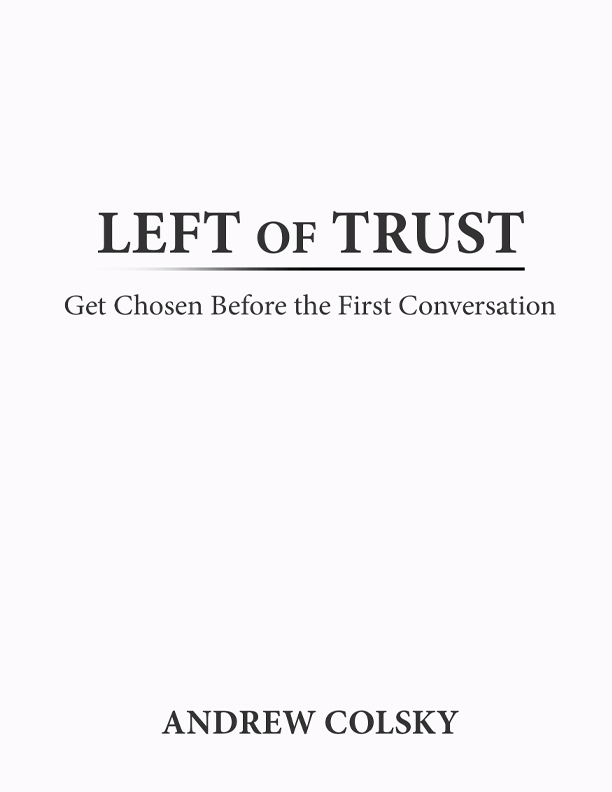
Left of Trust
Andrew's book on why excellent professionals get overlooked, and how to get chosen before the first conversation. Attorneys can read the first chapter free.
Read the first chapterReady to become the one clients pick?
New conversations every week on how professionals get recommended by AI search and chosen by real people.